Most small businesses don’t lose money because of bad products; they lose it because they don’t communicate at the right moment.
Small businesses often think growth comes from new marketing channels, more ads, or expanding their product offerings. But in reality, one of the most powerful and overlooked growth drivers sits quietly behind the scenes. And that is “consistent communication”.
Customers forget. Prospects disappear. Clients delay payments. Leads go cold. Appointments get missed.
All of this happens not because people are lazy, but because human attention is scattered.
This is why Automated Communication has become one of the highest ROI systems any small business can implement. Whether you run a service company, online store, consultancy, agency, or local business, communication automation directly impacts your revenue, customer retention, and operational efficiency.
In this blog, we’ll explore what automated communication really is, why it’s rising in importance, how it increases revenue, and which forms of communication matter most for small businesses in 2025 and beyond.
Most people hear “automation” and think of a huge number of emails distributed or scheduled newsletters. That’s only the surface level.
Modern Automated Communication refers to a fully integrated system of:
Instead of manually messaging customers, the system responds to you based on what customers do, or don’t do.
Examples include:
Automated Communication ensures your business always shows up even when you’re busy, offline, or overwhelmed.
This means there are no delays, no forgotten messages, and no missed opportunities.
Automation used to be something only tech giants and enterprise companies could afford. Platforms like Salesforce, HubSpot, and Marketo dominate the automation landscape.
But now, automation has become accessible to small businesses thanks to modern tools and easier integrations.
According to the “Small Business Tech Trends 2025” blog (KnowFireRisk), 63% of small businesses are now using automation to increase efficiency and revenue.
Here’s why this shift is happening:
The modern customer expects:
Delayed or inconsistent communication leads to:
Automation solves this by ensuring responses go out at the exact moment when they’re needed.
Small businesses lose money every day because humans simply forget:
Automated Communication removes human error from the equation and ensures the right message is sent at the right time.
Small business owners wear many hats:
But consistent follow-up requires time that most small businesses don’t have.
Automation lets businesses:
In short, your system becomes your assistant.
When communication is consistent and timely, customers naturally feel:
This tends to increase:
In a world where attention spans are shrinking, experience-driven communication becomes a competitive advantage.
The true strength of automated communication is that it directly influences revenue, not just engagement or convenience.
Here are the biggest revenue drivers:
Late payments and forgotten invoices are a hidden revenue loss for small businesses.
Automated invoice reminders via email and SMS greatly reduce:
Studies show that automated reminders cut overdue payments by 50%.
Even simple sequences like:
Can recover thousands per month.
Tools like Retenva integrate with systems such as Stripe and QuickBooks to automate these reminders without manual follow-up.
When leads receive:
They convert at much higher rates.
Research shows B2B buyers engage with an average of 7.9 touchpoints before making a decision. Many small businesses, however, only attempt 1–2 follow-ups, missing out on critical conversion opportunities.
Automation bridges that gap by delivering consistent follow-ups without requiring extra effort.
Appointment-based businesses lose huge amounts of money from no-shows.
SMS reminders can reduce no-shows by up to 38%.
Examples:
This single automation increases revenue without any new marketing.
Retention is the strongest revenue driver.
Automated Communication ensures customers receive:
A study by Bain & Company shows that a 5% increase in retention can raise profits by up to 95%.
Automation makes that retention reliable and predictable.
Automation eliminates:
A smoother customer experience leads directly to:
In competitive industries, communication quality becomes a revenue differentiator.
While many tools focus solely on marketing automation, Retenva is among the platforms that combine:
This unified approach lets small businesses automate both customer engagement and revenue collection, a combination that is overlooked by many platforms
Retenva’s role is simple: To ensure businesses stop losing money due to missed communication.
Although “automation improves efficiency” sounds nice, the real question every business owner asks is:
“How does this actually make me more money?”
To answer that, we need to examine real-world scenarios, proven psychological principles, channel performance data, and the actual financial outcomes of implementing Automated Communication across a small business.
Human behavior follows predictable patterns:
People forget.
People procrastinate.
People avoid tasks that feel heavy.
People respond when prompted at the right moment.
Automated Communication leverages these behavioral realities by sending messages when customers are most likely to take action.
The Behavioural Insights Team has found that timely SMS reminders can meaningfully boost task completion in learning environments, for example, they increased online course completion rates by a few percentage points in controlled trials.
Let’s break down the psychology that makes automation so effective.
A message delivered at the exact moment a person is thinking about a task massively increases response likelihood.
Examples:
Timeliness equals relevance, and relevance is the strongest form of communication.
Once a customer takes an initial action, signing up, booking, or buying, they enter a short window of high engagement.
Automated Communication nurtures this energy with:
This increases conversion because customers feel guided and supported.
Nudges work because they remove friction.
A simple SMS like:
“Hey! Just a reminder, your appointment is tomorrow at 10 AM. Reply YES to confirm.”
Reduces cognitive load and improves follow-through.
A study by SimpleTexting shows that SMS nudges have a 98% open rate, making them one of the strongest communication tools on the planet.
When communication is consistent, customers perceive a business as:
This trust translates into repeat purchases and referrals, both major revenue drivers.
Let’s break down real scenarios in different industries to show how automation directly produces financial gains.
These examples reflect standard market data and the observable results shared across industries using email and SMS automation.
A salon, fitness trainer, dentist, consultant, or home service provider loses money every time a customer doesn’t show up.
Average loss per no-show: $60–$200+
With automated communication:
Impact: No-shows drop by 30–50%
Revenue gained: Hundreds to thousands per month
These businesses rely on speed-to-lead.
If you don’t respond fast, competitors will.
With automated workflows:
Impact: Lead conversion increases 20–40%.
People trust the business that replies first.
The average cart abandonment rate is 70.19%, (Baymard).
Automated Communication solves this with:
Impact: 10–20% of abandoned carts can be recovered.
That’s pure recovered revenue.
Losing customers directly impacts growth.
With Automation:
Impact: Churn drops 15–30%.
That’s long-term revenue protection.
Late payments are a universal problem.
Data from Stripe shows that automated invoice reminders significantly increase on-time payments.
With Automated Communication:
Impact: Faster payments and fewer overdue invoices.
Businesses gain predictable cash flow instead of chaotic billing cycles.
Both are powerful, but for different reasons.
Email offers detail, depth, and design.
SMS has unmatched open and response rates.
This is where cross-channel automation shines:
Small businesses often see the biggest revenue lift from email + SMS together, not separately.
There’s a silent cost every small business pays without realizing it.
These costs stack up and eventually limit growth.
Automation removes them.
Manual follow-ups waste hours weekly.
Owners spend valuable time:
Automated Communication frees that time instantly.
A forgotten follow-up can mean:
Automation recovers these opportunities automatically.
When communication depends on memory, the experience becomes inconsistent.
Automation prevents:
Consistency increases revenue.
Business owners get overwhelmed with repetitive communication.
Automation tends to:
A healthy business operator makes better decisions and better profits.
Retenva simplifies Automated Communication by offering:
Its standout feature is the ability to sync invoices from systems like Stripe or QuickBooks and automate payment reminders, something many automation platforms overlook.
But remember: Retenva is just one option.
The principles you’re learning here apply to any solid automation platform.
By now, you understand what Automated Communication is and how it directly increases revenue.
But the real question is:
“How do I implement this in my own business, without complexity, high costs, or technical headaches?”
Let’s see core automations every small business should set up, the mistakes to avoid, and the long-term advantages of running a communication system that never forgets, never gets tired, and never misses opportunities.
Every successful automation system, whether used by large companies or small local businesses, rests on four foundation pillars:
When these four work together, you get a business that feels like it’s powered by an invisible assistant working 24/7.
Let’s break them down.
This refers to all the essential communications a customer should receive throughout their interaction with your business.
Lifecycle automation often includes:
According to Salesforce Research, 73% of customers expect businesses to understand their needs and communicate proactively. Lifecycle messaging is how you consistently deliver that expectation.
These are the essential workflows every small business should get running.
These automations make the business feel responsive, human, and organized, without requiring any extra work from you.
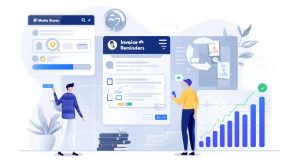
If lifecycle communication increases trust, revenue protection automation increases cash flow.
Revenue protection includes:
Small businesses rarely do these consistently because it takes time and feels awkward.
But automation solves both problems.
Marketing brings leads.
Sales convert them.
But cash flow decides whether the business survives.
Automated reminders dramatically reduce this because:
This sequence alone has recovered tens of thousands for small businesses across industries.
Tools like Retenva automate this across platforms like Stripe and QuickBooks, but the principle applies universally:
Your business needs automatic payment follow-ups.
Engagement is how often your customers think about you.
Retention is how often they spend money with you.
Automation boosts both.
With Automated Communication, you can send:
Customers forget businesses that never follow up.
Automation solves this permanently.
Retention isn’t luck, it’s communication.
Automated Communication makes it automatic.
This pillar turns businesses into brands.
Relationship-focused automation builds:
Humans crave connection, and automation helps maintain it, without being robotic.
Examples:
Small businesses win through relationships, and automation strengthens those relationships in scalable ways.
Here’s how to build your automation system without stress or complexity.
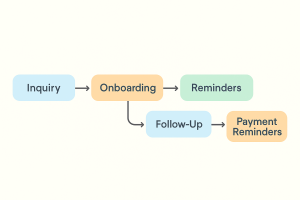
List the 8–12 main touchpoints where communication is needed.
For example:
These are your automation triggers.
Email is ideal for:
SMS is ideal for:
Both combined give the best results.
Each automation needs messages that match the moment:
Use friendly reminders, not forceful warnings.
These are the “must build now” automations:
They provide an immediate revenue rise.
Once the essentials are running, add:
Automation grows with your business.
Even great automation can fail if implemented incorrectly.
Here are the biggest pitfalls to avoid:
More communication isn’t always better.
The goal is relevance, not volume.
People respond to personality.
Automation should feel human, not automated.
Email alone is not enough.
SMS drives urgency and visibility.
This is the most profitable form of automation, yet the most ignored.
Use insights to refine:
Better data = Better automation.
While many tools focus only on marketing automation, Retenva helps users combine a streamlined platform:
Its ability to sync invoices across platforms like Stripe and QuickBooks and send automatic reminders is especially valuable for small businesses that suffer from late payments.
But whether you use Retenva or any other solution, the point remains:
Automated Communication is one of the highest ROI systems a business can implement.
Small businesses that automate:
Those who don’t?
They slowly fall behind.
Automation isn’t a trend.
It’s a competitive advantage, one that becomes stronger with every workflow you build.
Your business becomes:
This is the assurance of Automated Communication, and it’s available to businesses of any size, in any industry, starting today.